


24-hour home care in Florida provides continuous, non-medical support for older adults who need assistance or supervision throughout the day and night. It can help a senior remain in familiar surroundings while receiving support with personal care, mobility, meals, household routines, companionship, and overnight needs.
Families often begin exploring around-the-clock care after a fall, hospital stay, change in mobility, or increase in nighttime confusion. Others recognize that a spouse or adult child can no longer safely manage caregiving alone.
However, the phrase “24-hour home care” does not always describe the same arrangement. Care may involve rotating caregiver shifts, daytime support combined with overnight coverage, or another model based on the senior’s needs and provider availability.
Understanding these differences can help Florida families choose a safe, sustainable care plan.
|
Quick answer: 24-hour home care provides caregiver coverage across the full day and night. Non-medical caregivers may assist with personal care, meals, mobility, medication reminders, companionship, light housekeeping, dementia support, and overnight routines. Confirm how shifts are structured, whether overnight caregivers remain awake, and how backup coverage is handled. |
What Is 24-Hour Home Care in Florida?
24-hour home care is an in-home care arrangement designed to prevent gaps in support. A caregiver is present in the home throughout the day and overnight according to an established care plan.
Continuous care often involves multiple caregivers working scheduled shifts. This allows caregivers to rest between shifts while ensuring the senior has support at different times of day.
The purpose is to provide assistance where it is needed while encouraging the older adult to remain involved in routines, decisions, and meaningful activities.
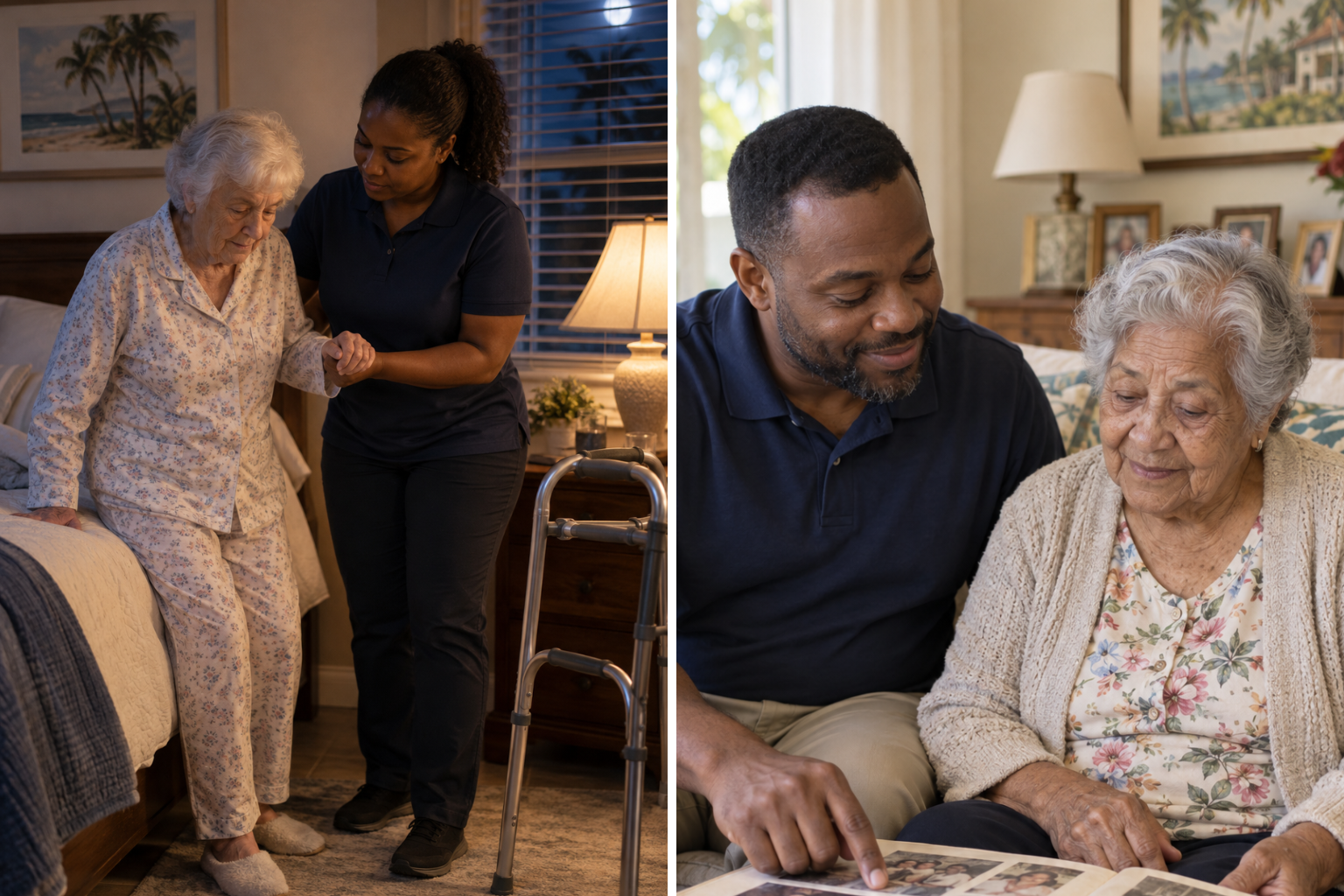
For example, a caregiver may help someone get out of bed, prepare breakfast, provide a medication reminder, and assist with bathing. Later shifts may include dinner preparation and reassurance if the person becomes confused at night.
Home Halo provides non-medical home care rather than skilled medical treatment. Our guide to home care versus home health care explains the distinction.
Some older adults receive both services. A home health professional may provide intermittent nursing or therapy, while non-medical caregivers assist with daily routines between clinical visits.
In-Home Care for Seniors & Veterans
Compassionate, personalized in home care designed to help seniors live safely and independently in the comfort of home. Our trusted home care services provide daily support, companionship, and specialized senior home care giving families peace of mind every step of the way.
How Does 24-Hour Home Care Work?
A responsible care plan begins with an assessment of the senior’s needs, preferences, home environment, and existing family support.
Discuss current concerns
The initial conversation may cover personal care, walking and transfer safety, falls, meal preparation, medication routines, memory changes, nighttime waking, and family caregiver availability.
Describe what actually happens during uncovered hours. Is your parent forgetting meals, trying to walk without assistance, or calling for help several times overnight? These details help the provider recommend an appropriate schedule.
Create a personalized care plan
The care plan identifies caregiver tasks, scheduled hours, and personal preferences. It should explain how caregivers communicate important observations to authorized family members.
Include routines that matter to the senior, such as a preferred breakfast time, an afternoon phone call with a friend, or time spent with a pet.
Schedule daytime and overnight coverage
Many 24-hour schedules use rotating shifts. One caregiver may provide daytime support while another covers evenings or overnight hours.
Ask exactly how the proposed schedule works. In particular, confirm whether the overnight caregiver will remain awake or have designated sleeping periods.
Plan clear shift handoffs
When caregivers rotate, clear communication helps maintain continuity. A handoff may cover meals, hydration, personal care, toileting, mood, sleep, and changes requiring follow-up.
Ask how this information is documented and shared while protecting the client’s privacy.
Review the plan as needs change
A senior recovering from surgery may reduce care hours as strength returns. Someone with a progressive condition may require additional support over time.
Review the plan after a fall, hospitalization, increased confusion, change in mobility, or significant change in family availability.
What Can a 24-Hour Caregiver Help With?
The services included in 24-hour home care in Florida depend on the provider, the caregiver’s permitted scope, and the individual care plan.
Personal care and daily routines
Caregivers may assist with bathing, grooming, dressing, toileting, oral care, and incontinence routines. Respectful personal care assistance can help seniors maintain dignity while completing tasks that have become difficult or unsafe.
Support should reflect what the senior can still do independently. Someone may need help getting into the shower but prefer to wash their own face or choose their clothing.
Mobility and fall prevention
A caregiver may help an older adult walk through the home, change positions, or complete transfers when appropriate to the care plan and caregiver training.
Combine caregiver support with fall prevention strategies for seniors, such as improving lighting, removing trip hazards, and using recommended mobility equipment. Repeated falls should also be discussed with a healthcare professional.
Meals and hydration
Continuous care may include meal planning, grocery assistance, food preparation, hydration reminders, and kitchen cleanup. Caregivers can support established dietary instructions and report concerns about skipped meals or difficulty eating.
Hydration routines should follow the person’s healthcare guidance, including any prescribed fluid restrictions.
Medication reminders
Non-medical caregivers may provide reminders according to an established care plan. They can help maintain routines and report concerns to the appropriate family member or care professional.
Reminders differ from clinical medication management. Caregivers do not independently prescribe medications, change dosages, or make medical decisions. Learn more about medication reminders for seniors.
Home management assistance
Light housekeeping may include laundry, changing linens, washing dishes, organizing frequently used items, and household errands. These services generally focus on areas and routines used by the person receiving care.
Clarify expectations before services begin. Routine housekeeping is different from deep cleaning, heavy lifting, or home maintenance.
Companionship and engagement
Caregivers can provide conversation, reassurance, and meaningful interaction. Activities might include listening to music, looking through photographs, playing games, taking walks, or completing crafts.
The best activities reflect the senior’s interests. Care should leave room for privacy and quiet time, too.
Dementia support
A person living with dementia may benefit from consistent routines, familiar caregivers, redirection, meal support, and supervision.
Continuous coverage may become appropriate when memory changes affect safety awareness, sleep, eating, hygiene, wandering risk, or the ability to respond to a problem. Explore additional strategies in our guide to caring for someone with dementia at home.
Overnight assistance
Nighttime support may include toileting, walking and transfers, repositioning, reassurance, and established bedtime routines. These tasks must fit the care plan and caregiver’s abilities.
If nighttime assistance is the primary concern and daytime needs are already covered, overnight care may be sufficient without a full 24-hour schedule.
Is 24-Hour Care the Same as Live-In Care?
Not necessarily. Terminology varies between providers, so compare the actual schedule rather than relying on the name alone.
24-hour or 24/7 home care
This usually refers to continuous coverage throughout the day and night. Multiple caregivers may rotate through scheduled shifts. It may suit someone who cannot safely be left alone or needs unpredictable help at different hours.
Live-in care
A live-in caregiver stays in the senior’s home for an extended period. The arrangement generally includes sleeping accommodations, meals, breaks, and rest periods, subject to applicable rules.
Live-in care does not automatically mean an awake caregiver is available all night. Ask who provides assistance during rest periods and whether the arrangement can safely meet frequent nighttime needs.
Overnight care
Overnight care covers a defined nighttime period. The caregiver may remain awake or may be allowed to sleep when assistance is not needed, depending on the agreement.
Confirm which structure is offered and what happens if the senior begins needing more frequent help.
Part-time or hourly care
Part-time care covers selected blocks of time, such as morning personal care, meals, transportation, or evening routines. If risks occur only at predictable times, a targeted schedule may be more appropriate than continuous care.
For a broader overview, read our national guide to 24-hour home care for seniors.
When Should a Family Consider 24-Hour Care?
No single diagnosis automatically means a senior needs continuous care. Families generally consider it when several concerns overlap or help may be needed unpredictably throughout the day and night.
Potential signs include:
- The senior is no longer safe when alone.
- Falls, near falls, or unsafe attempts to walk are increasing.
- Dementia causes wandering, confusion, or unsafe decisions.
- Nighttime waking and requests for help have become frequent.
- Meals, hydration, or personal care are regularly missed.
- A hospital discharge creates significant support needs.
- Family caregivers cannot reliably cover necessary hours.
- A spouse providing care is exhausted or has their own health concerns.
Our guide to the signs an older adult may need home care can help start the conversation.
Sometimes continuous care is temporary, such as after rehabilitation or while a primary caregiver recovers. If concerns are limited to certain hours, respite care in Florida or a shorter schedule may be enough.
Sudden changes in alertness, behavior, or mobility need medical attention, not simply more caregiving hours. For an immediate medical emergency, call 911.
Florida-Specific Factors to Consider
Florida families should consider weather, distance, and seasonal living arrangements when planning around-the-clock care.
Hurricane and evacuation planning
A home care schedule does not replace an emergency plan. Discuss these questions before a storm threatens:
- Where will the senior go if evacuation is ordered?
- Who will provide transportation and help with mobility?
- How will medications, supplies, and documents travel with them?
- What happens if a caregiver cannot safely reach the home?
- How will essential powered equipment be supported during an outage?
- Who will communicate changes to relatives and the agency?
The Florida Division of Emergency Management provides planning resources for people who need electricity for medical equipment, evacuation transportation, or medication assistance.
Registration with the Florida Special Needs Registry does not automatically guarantee placement in a special-needs shelter. Confirm local procedures and shelter eligibility in advance.
Heat and hydration
Include the senior’s established hydration routine, indoor cooling needs, and outdoor activity preferences in the care plan. Follow healthcare guidance rather than assuming every older adult should drink the same amount.
Plan for what happens if air conditioning stops working, especially when the person cannot independently leave the home. Caregivers and family members should know whom to contact for urgent concerns.
Long-distance family caregiving
An adult child in another state may coordinate care for a parent in Jacksonville, Orlando, Tampa, or another Florida community. Agree on a primary family contact, a routine update schedule, and which changes require an immediate call.
Ask providers about coverage at the exact address. Service areas, travel distances, and overnight staffing can differ even within one region.
Seasonal residency
Some Floridians divide their time between states. Ask how changing residences affects provider availability, insurance benefits, care records, and scheduling.
A care agreement does not automatically transfer to another state or agency. Arrange a handoff before travel so the receiving provider understands current needs.
Trusted Home Care Services
At The Home Halo®, we are a trusted home care agency dedicated to providing non medical home care, companion care, and caregiver services that support independence, dignity, and comfort at home.
How Much Does 24-Hour Home Care in Florida Cost?
There is no single statewide rate. Costs depend on the community, level of assistance, shift structure, overnight requirements, and provider policies.
Continuous coverage involves substantially more hours than part-time support. Request a written estimate for the complete schedule rather than comparing hourly rates alone.
Ask the provider to explain:
- Hourly, overnight, weekend, and holiday rates
- Minimum shifts or weekly hours
- Whether awake overnight coverage costs more
- Included services and any transportation charges
- Deposits, cancellation terms, and schedule-change policies
- Backup staffing arrangements
- How future rate changes will be communicated
Compare both cost and service. A lower quote may reflect a different overnight arrangement or fewer included hours. Confirm that each proposal addresses the same care needs.
How Do Florida Families Pay for 24-Hour Home Care?
Many families pay privately. Insurance or public programs may help with certain approved services, but benefit eligibility does not guarantee payment for a full 24-hour schedule or a particular provider.
Long-term care insurance
Some policies reimburse eligible in-home care. Coverage may depend on benefit triggers, a waiting or elimination period, daily limits, and approved-provider rules.
Contact the insurer before beginning services. Ask what documentation is required, whether the provider qualifies, and how much the family will pay out of pocket.
Medicare
Medicare does not pay for 24-hour-a-day care at home. It also does not cover custodial or personal care when that is the only care needed.
Certain intermittent skilled home health services may be covered for eligible beneficiaries. Those benefits differ from continuous non-medical care. Review Medicare’s home health coverage guidelines and verify benefits directly.
Florida Medicaid
Florida’s Statewide Medicaid Managed Care Long-Term Care program may provide home- and community-based services to eligible individuals. Financial and clinical requirements apply.
The screening process begins through an Aging and Disability Resource Center and may involve a waiting list. Families can call Florida’s Elder Helpline at 1-800-963-5337 for guidance.
Confirm authorized services, hours, and participating providers with the relevant plan. Do not assume enrollment will fully fund continuous care.
Veterans’ benefits
Eligible Veterans may receive help through the VA’s Homemaker and Home Health Aide Care program. These services can support daily activities at home.
Clinical need, authorization, availability, and contracted-provider requirements apply. Speak with the Veteran’s VA social worker or care team about approved services and hours.

How to Choose a 24-Hour Home Care Provider in Florida
Ask detailed questions about staffing, communication, and accountability before signing an agreement.
- What does your agency mean by 24-hour, live-in, and overnight care?
- Will a caregiver remain awake overnight if needed?
- How are caregivers screened, trained, and supervised?
- Are caregivers employees, and who handles their employment responsibilities?
- How many people will be on the regular care team?
- How do you match caregivers with clients and document handoffs?
- How will authorized family members receive updates?
- What happens if a caregiver calls out or a shift cannot be filled?
- Which tasks fall outside the caregiver’s permitted scope?
- How are falls, sudden changes, and urgent concerns handled?
- Can the schedule increase or decrease as needs change?
- What licensing or registration and insurance information can you provide?
- What is the complete expected cost?
- Who should the family contact with concerns?
Request a written care plan and service agreement. A provider should explain both what it can offer and the limits of its services.
How to Build the Right Care Schedule
Start by recording when help is needed over several days, including overnight. Note personal care, meals, walking, transfers, reminders, confusion, bedtime, and waking.
Next, identify who currently covers each need and where gaps remain. Include the older adult in the conversation as much as possible. Ask what feels hardest, which routines matter most, and what they want to continue doing independently.
Compare more than one workable option. Full coverage may be appropriate, but overnight assistance plus selected daytime hours may also meet the need.
Agree on a review date after care begins. Evaluate caregiver fit, communication, uncovered needs, the senior’s comfort, and whether the schedule is financially sustainable.
Explore 24-Hour Home Care in Northeast Florida
Home Halo of Northeast Florida provides personalized, relationship-driven, non-medical home care to help older adults remain at home with support for daily routines.
Depending on individual needs and local availability, schedules may range from a few hours per week to overnight or continuous support. The Northeast Florida team serves Baker, Clay, Duval, Flagler, Nassau, St. Johns, and Volusia counties, including communities around Jacksonville, St. Augustine, Palm Coast, and Daytona Beach.
Contact Home Halo of Northeast Florida to discuss the times of day creating the most concern and confirm available services at your loved one’s address.
Trusted Home Care Services for Seniors & Families
Finding the right home care services for seniors and elderly loved ones can be overwhelming. We make it simple by connecting families with compassionate and reliable in-home care solutions tailored to individual needs.
Frequently Asked Questions About 24-Hour Home Care in Florida
Is 24-hour home care the same as 24/7 home care?
The terms are often used interchangeably, but providers structure coverage differently. Ask whether caregivers rotate in shifts, whether nighttime coverage is awake or sleeping, and how rest periods are covered.
Does one caregiver work for 24 hours?
Continuous care usually involves multiple caregivers working scheduled shifts. A live-in arrangement may use a different structure with sleeping and rest periods. Request a clear written schedule.
Can 24-hour home care help someone with dementia?
It may help when dementia affects safety, sleep, personal care, eating, or the ability to remain alone. The plan should reflect the person’s abilities, routines, and risks, alongside appropriate medical guidance.
Does Medicare cover 24-hour home care in Florida?
Medicare does not pay for 24-hour-a-day care at home or personal care when that is the only care needed. It may cover certain intermittent skilled home health services for eligible beneficiaries. See Medicare’s coverage information.
Can 24-hour care be temporary?
Yes. Families may arrange continuous care after a hospital or rehabilitation stay, during a family caregiver’s absence, or while determining a longer-term plan. Confirm minimum scheduling requirements and cancellation terms.
Is 24-hour home care a replacement for nursing care?
No. Non-medical care does not replace skilled nursing, physician care, therapy, hospice, or emergency services. Families may use daily living support alongside clinical services from other providers.
How do we know whether 24-hour care is necessary?
Consider when risks and unmet needs occur. A targeted schedule may be sufficient for predictable concerns. If help or supervision is needed unpredictably throughout the day and night, discuss continuous coverage with the provider and appropriate healthcare professionals.
This article is for general educational purposes and is not medical, legal, insurance, or financial advice. Services, payment programs, caregiver scope, staffing arrangements, and availability vary by provider and individual circumstances.